Showing posts with label Ourense. Show all posts

24/02/2018

Remembering Rosalía de Castro (1837-1885)

Many events are being held today all over Galicia in memory of one of our greatest poets, Rosalia de Castro. 

Rosalía de Castro por Luis Sellier. Wikipedia
She was born in Santiago de Compostela 181 years ago, on February 24, 1837.

Casa-museo de Rosalía en Padrón. Rosalíadecastro.org
She wrote poems and prose in Galician (Cantares Gallegos, Follas Novas, Contos da Miña Terra) and in Spanish (A Mi Madre, En Las Orillas del Sar) and her work has been translated into languages like English, French, Japanese and Portuguese.

Three ESO students, Adriana, Carlos and Álex have recorded a special podcast to celebrate such an important day for poetry lovers. 


Primary school students have also celebrated Rosalía de Castro’s Day by colouring pop-art illustrations of the poet and reciting some of her best-known poems with the help of their families!


Thanks a million!

22/06/2017

Discover Ourense XXXIX: The Door of Paradise

Postcard 56 shows one of the chief artworks in Ourense's Cathedral, the Door of Paradise (Pórtico do Paraíso). 


This 13th-century pórtico was built by students of Master Mateo, best known for his Pórtico da Gloria in the Cathedral of Santiago de Compostela. Its three arches are supported by columns with a central mullion. The apostle St James holds a sword reminiscent of his alleged miraculous participation in the legendary Battle of Clavijo.


Other decorations include Christ being tempted by the devil, a medallion of God the Father and a tabernacle presenting St Martin tearing his cloak. 


The archivolts of the central arch bear the figures of the 24 elders from the Book of Revelation. The columns themselves are sculpted with apostles and prophets while the capitals present a variety of figures including Christ's temptations in the desert, centaurs fighting mermaids, dragons and harpies with frightening faces who were said to have brought the plague.


03/03/2017

Discover Ourense XXXVII: Parque do Toural, Xinzo de Limia

Postcard 53 features one of the landmarks in Xinzo de Limia: o Parque do Toural. If you remember, postcards 14 and 24 featured the Pantalla, Xinzo's most popular fancy dress during Carnival celebrations.
O Parque do Toural is a beautiful park where families go to spend their afternoons playing and chatting. It has a lovely fountain at its centre, perfect to beat the heat in scorching summer days.


To know more about Xinzo, click HERE.

24/10/2016

Discover Ourense XXXVI: "Cruceiros" (Galician Stone Crosses)

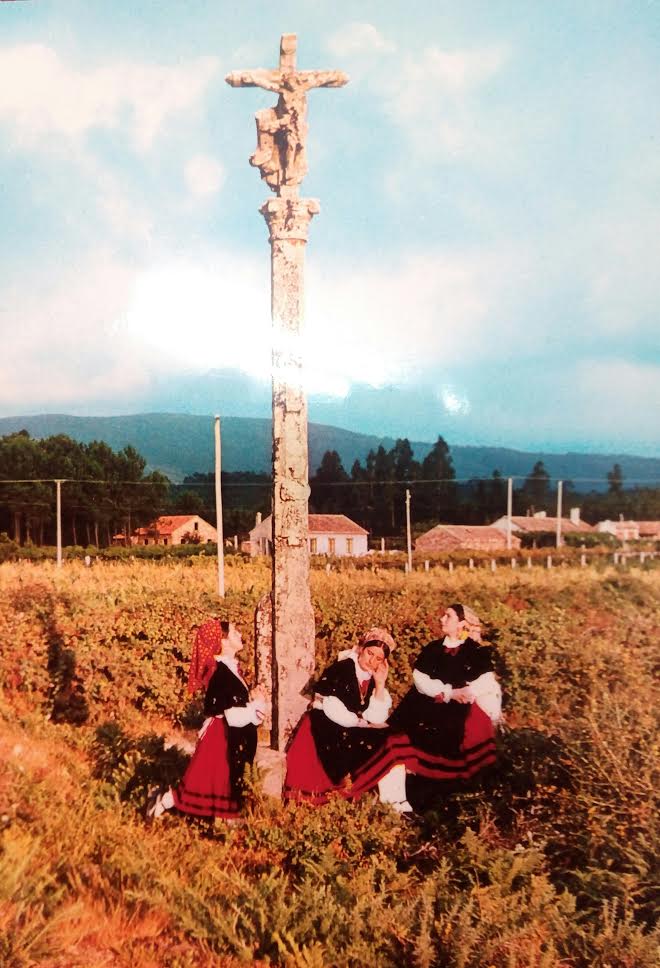
Postcard 49, sent by Ciencia Activa students, features one of the most distinctive Galician landmarks, "os cruceiros", stone crosses on long slender shafts that be found in a town or city main square and also at some random point on a road, usually a crossroads (where roads intersect)


Cruceiro de Castillón
Galician cruceiros often include small sculptures of Christ on the cross on one side and a Madonna and Child on the other.


Their origin is uncertain yet most historians agree that the cruceiros’ origin can be traced back to the lares (laribus vialibus) or gods of the hearth that magically protected the road and to whom the Romans dedicated altars with inscriptions, mainly building them by crossroads. Ancient Galicians would light candles on the altars because they believed they were connected with the underworld. As the Christianization of the region progressed in the course of the Middle Ages, said altars were torn down and in their place the cruceiros were put up. The oldest cruceiros are said to date back to the thirteenth century and have continued to be built into the twentieth  century.


Click here to read more about the cruceiros.

16/06/2016

Discover Ourense XXXV: The Spa of as Burgas

Postcard 41 (sent to the German town of Ruesselheim) features a recently built spa area located right behind As Burgas water springs.

Piscina termal As Burgas. Termasourense.com
The spa of as Burgas was inaugurated in 2010 and uses the natural spring of the Burgas, which, as you know from previous posts, continuously produces over 300 litres of water per minute at 67 ºC. The design of the spa, an outside heated pool, was the work of the architect Cesar Portela and its unique integration into the old town makes it one of the very few urban spas in Spain.

Piscina termal As Burgas. Termasourense.com

The water, at 37ºC, is recommendable for skin conditions and rheumatism.


15/06/2016

Discover Ourense XXXIV: Saint Michael Mozarabic Chapel in the Monastery of San Salvador, Celanova

Postcard 40 features a gem of a chapel dedicated to Saint Michael the Archangel and located in the garden of the Monastery of San Salvador in Celanova, a town of 6,000 inhabitants located 23 km from Ourense.

Location of Celanova in the province of Ourense. Wikipedia

The Monastery of San Salvador is Celanova’s most important building in a well-preserved historical center. It was founded by St. Rudesind (San Rosendo) in 936. The nave is considered the most perfect Galician Baroque church.

Monastery of San Salvador de Celanova. Main façade. Galicia en fotos.com

Cloister Monastery of San Salvador de Celanova. Residenciabarroso.com
Saint Michael’s Chapel happens to be one of the best preserved pre-Romanesque monuments in Spain.

Capilla de San Miguel. Celanova. Absoluteourense.com
Completed in the year 942 (10th century), the chapel has a Mozarabic style and consists of a nave, from where it is accessed, with a barrel vault, the central body  crowned by an inner brick cross vault, and a prominent outer overhang, and an apse, square on the outside and round in the inside, topped by a dome.

Capela de San Miguel. Turismo.gal
Despite its small windows, the chapel’s interior is incredibly luminous. In fact, its orientation is such that it captures the light of the rising sun at the equinoxes of spring and autumn.

Espectacular equinoccio Capilla de San Miguel. LaRegion,es
Sources:


14/06/2016

Three year-old Postcrossers discover Ourense's Old District

Our Very Very Young Postcrossers are going to send one more postcard before summer holidays begin and so they’ve been taken on a walking tour of the old town by their teachers Tamara and Yolanda in order to discover some of its most important spots.


Stop 1: Ourense’s Praza de Abastos (Wholesale Food Market)
Located right behind the Alameda, one of Ourense’s main parks, the Abastos market is the best place to buy fresh local products. The main building was designed by the architect Manuel Conde and built in 1929. It houses dozens of family businesses that fall into one of the following categories: fish and seafood, fruits and vegetables, meat, cheeses, bread and pastries. 


One of the Praza de Abastos’s peculiarities is its outside, where you can visit small flower stands and popular stalls in which products of the nearby orchards, fruit and vegetables are sold along with local wines, pies, the so-called “Pan de Cea” (Cea Bread) and many other products of the land.

Pan de cea. Cocinagallega.es

Stop 2: As Burgas
As you already know from a previous post, As Burgas are Ourense’s best known hot water springs. Medicinal mineral water gushes out from three sources: “Burgas de Arriba”, “Burgas do Medio” and “Burgas de Abaixo”. Water temperature is really high, between 64ºC and 68ºC, and the volume of water flowing daily is impressively high too: over 4 million litres!


Stop 3: Main Square
The Main Square was featured in the first postcard sent in this project. The Praza Maior is a sloped square enclosed by various stunning buildings with arcades to protect pedestrians from the rain and the wind. The two traditional powers of the city are located here: the Town Hall and the Bishop's Palace.


Stop 4: Town Hall
The Town Hall is the main administrative building in Ourense; it houses the town council, its associated departments, and their employees, who work to promote and enhance the quality of life in Ourense.


Stop 5: Praza Bispo Cesáreo
This is a lovely little square named after a well known 19th century bishop. Its Baroque water fountain at its center came from the Mosteiro de Oseira, a Cistercian monastery dating back to the 12th century.


Stop 6: The Alameda Park
The Alameda is the oldest park in town, Formerly the town hall’s gardens (“A Horta do Concello”), the Alameda was transformed in the 19th century into a park for the enjoyment of all the ourensanos.


Its transformation was commissioned to Vázquez Gulías, who built amazing modernist constructions such as the palco da música (music kiosk):


Thanks a million Tamara and Yolanda for taking us on this tour to discover the history of some of Ourense’s marvels!


13/06/2016

Discover Ourense XXXIII: Ponte do Milenio (II)

As you know from aprevious post,  A Ponte do Milenio (Millenium Bridge) is the fifth bridge on the river Miño. It is a-state-of-the-art construction that was inaugurated in the year 2.001. It was designed by the architect Alvaro Varela and the engineer Juan M. Calvo, who combined steel and concrete to build one of Ourense’s most important landmarks.

Ponte do Milenio Ourense. Ourenses.com

It is  situated 500 metres from the Roman Bridge and the contrast between the most ancient bridge and the most modern is definitely an image photographed by everyone who visits the city. It is the contrast what Lucía wanted to show in the postcard she made.

Pontes Ourense. Galeon.com
Some people call it the Bridge of the seagull since you can see the silhouette of a seagull with its wings deployed on the river.
Ponte do Milenio. Ourenses.com


27/05/2016

Discover Ourense XXXII: Fish Farm in O Carballiño

Postcard 38 shows O Carballiño's fish farm, situated at the end of the walk of a residential area and the Local Park, in a haven of the river Arenteiro, near a Labandeira, in a foothill of the place known as Filomeno’s Island.


The fish farm was opened in 1961 and it was dependent on the Institute for the Conservation of the Nature (ICONA) until it was transferred to the Xunta de Galicia.

Piscifactoría do Carballiño. Carballiño.gal
Many of the trouts that are breeded in this fish farm are used in many Galician rivers.


Piscifactoria Carballiño from Albert Brull Gracia on Vimeo.

10/05/2016

An outing to Saint Martin's Cathedral

Saint Martin's Cathedral is one of the main landmarks in Ourense and, as you may well remember, it has been featured in postcards 10 (Germany), 23 (Belgium) and 35 (Sweden). This is why we have planned an outing with our Very Young Postcrossers to appreciate the beauty of this magnificent building.


To do so, we’ve had the inestimable help of Rocío Naveira, our language therapist, and Carlos Vélez, one of the coaches of the school’s basketball team.


Here’s the itinerary we have followed: 


On our way to the cathedral, we stopped at the Praza Maior in order to contemplate its stunning buildings and arcades.


Once at the cathedral, we were told that it is named after Ourense’s patron saint, Saint Martin, and we were taken on a guided tour to discover the treasures of this landmark, including its Main altar…  

                          
its stained glass windows…


its impressive Portal of Paradise…


Christ’s Chapel


and its huge bells.


Thank you to the Diocese of Ourense for giving us the opportunity to explore this wonderful monument!