The postcard received today comes from Brussels! Yet, it does
not show any Belgian landmark. Veerle, our Bruxelloise friend, has chosen a card featuring
the last place she has travelled to, which happens to be a wonder of the Ancient
World!
As Veerle tells us, she has recently visited the ruins
of Myra, an ancient Greek city situated in what is known today as Antaly, on
the southeastern coast of Turkey.
Visit EXPLORING PLACES to read about the history of
this enigmatic place.
The postcard received today shows one of the marvels
of the Ancient World: The ruins of Myra, an ancient Greek town in Lycia, located
on the river Myros (Demre Çay), in the fertile alluvial plain between Alaca
Dağ, the Massikytos range and the Aegean Sea.
…being one of the largest cities of Lycia, a
geopolitical region in Anatolia whose existence dated back to the Late Bronze Age
(1250–546 BC) and was incorporated into
the Roman Empire in the 1st century.
Myra's Greco-Roman theatre is the largest theatre in
Lycia and one of the main attractions of Myra. Its double-vaulted corridors are
still preserved and an inscription in a stall space reads "place of the
vendor Gelasius"- the location of an ancient concessions stand. It has 38 rows of seats and its facade was
richly decorated with theatrical masks and mythological scenes.
The famous rock-tombs of Myra are in two main groups,
one above the theater and the other in a place called the river necropolis on
the east side. Although most of the
tombs are plain today, Charles Fellows tells that upon his discovery of the
city in 1840 he found the tombs colourfully painted red, yellow and blue.
The earliest church of St. Nicholas was built in the
6th century AD, supposedly over St. Nicholas' tomb. Later it was rebuilt, the present church is
from the 9th century. It was further rebuilt in 1042 under the patronage of
Constantine X and a monastery was added at that time or shortly after. Excavations and restorations were done during
the 1960's and continue today from the early 1990's.
You can virtually explore the ruins of Myra by
watching this video:
Istanbul is the biggest city of Turkey with 15 millions of persons. It is located in the northwest of the country on the banks of BOSFORO, strait that separates Europe and Asia. It is one of the most fascinating places of the planet.
Istanbul is a city with a lot of contrast, sounds, colors, flavors, smells… It is magic and wonderfully chaotic and there went the capital of three empires: Roma, Byzantine and Ottoman. Istanbul is a famous for being a too oriental city to be an European an excessively western to be an Asian.
This wonderful landmark is a former Christianbasilica, later an imperial mosque, and now a museum (Ayasofya Müzesi). From the date of its construction in 537 until 1453, it served as a Greek Orthodoxcathedral and seat of the Patriarch of Constantinople, except between 1204 and 1261, when it was converted to a Roman Catholic cathedral under the Latin Empire.
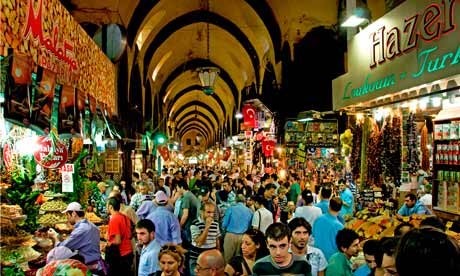
The Grand Bazaar is one of the largest and oldest covered markets in the world, with 61 covered streets and over 3,000 shops, which attract between 250,000 and 400,000 visitors daily.In 2014, it is listed No.1 among world's most-visited tourist attractions with 91,250,000 annual visitors!
Topkapi Palace was one of the major residency of the Ottoman sultans for almost 400 years (1465–1856) of their 624-year reign.It is among the monuments contained within the "Historic Areas of Istanbul", which became a UNESCOWorld Heritage Site in 1985.
The city of Istanbul is at a geographic crossroads, straddling Europe and Asia Minor and is divided by a sea lane called the Bosphorus Strait, which joins the Black Sea in the northeast and the Mediterranean Sea in the southwest. Cruises in the Bosphorus stand as one of the major tourist attractions in Istambul.
If you want to know more about Istanbul, watch the video below:
We've received a postcard from one of the most spectacular cities in the world: Istanbul, 3037 kilometres away!
The postcard depicts an illustration of one of Istanbul's landmarks, Topkapi Palace, which used to be the major residency of the Ottoman sultans for almost 400 years (1465–1856)!
Thank you, Eray, for this beautiful postcard, we love it! And thanks as well for having chosen a stamp that features a monastery in Spain, it was very nice of you!
If you want to know more about Topkapi Palace and the city of Istanbul, read what an ESO student, Adrián Gándara, has published on our section EXPLORING PLACES. Thanks, Adrián!
İzmir is a city in the western extremity of Anatolia, in Turkey. It has a population of 2,847,691, which makes it the third most populous city in the country, after Istanbul and Ankara.
One of the most emblematic elements of İzmir's harbor is the Clock Tower, a beautiful marble tower standing 25 m. It was designed by French architect Raymond Charles Père in 1901 to commemorate the 25th anniversary of the ascension of Abdülhamid II to the Ottoman throne in 1876.
The Asansör is one of Izmir’s best-known landmarks. Built in 1907 as a work of public service, it enables people and goods to pass from the narrow coastline of Karataş to the hillside.
The Izmir International Fair is the oldest tradeshow in Turkey and is notable for hosting a series of simultaneous festival activities. The fair and the festival are held in the compound of İzmir's city park named Kültürpark in the first days of September.
If you want to know more about Izmir, watch the following video:
Postcard 7 is heading to Izmir, one of the largest cities in Turkey.
This time it was an ESO 2 student, Carlos Cuesta, who was in charge of writing the postcard.
Hope Siyar likes our postcard, which features one of Ourense's most impressive landmarks, the Ponte do Milenio.
Carlos has done some research and has written an interesting text about Izmir. You can read it in EXPLORING PLACES. If you want to know more about the Millenium Bridge, visit the section DISCOVER OUR HOMETOWN.


_logo.jpg)