One of our ESO 4 students, Dani, has sent a postcard to Ghent, a Belgian city we know very well because we received a lovely postcard from here a few days ago!
Dani has chosen a postcard designed by one of his friends, Rubén Sotelo, which was chosen as one of the finalists in our Ourense-themed illustration contest.
Visit our section DISCOVER OURENSE to know more about Saint Martin's Cathedral. Remember you can find detailed information about Ghent in EXPLORING PLACES.
The city started as a settlement at the confluence of the Rivers Scheldt and Leie and in the late Middle Ages became one of the largest and richest cities of northern Europe with some 50,000 people in 1300.
One of the best views of Ghent's Medieval buildings can be enjoyed from St. Michael's Bridge. The bridge is located just two or three blocks down the road from the churches and cathedrals.
Saint Michael's Bridge. Photo courtesy of Patricia Losada
Belfry
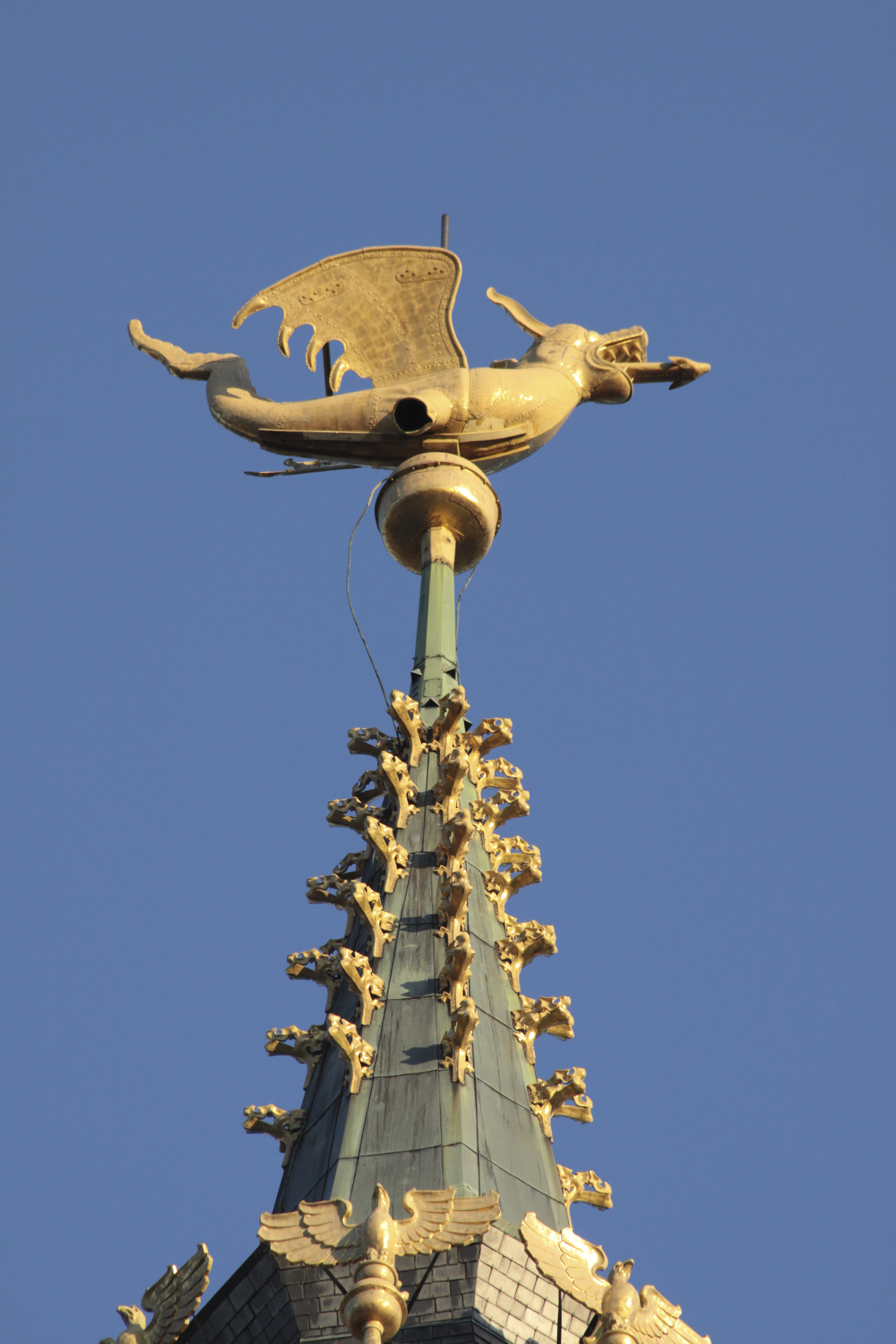
The Belfry is the proudest symbol of the city’s independence.
The Cloth Hall was built onto the side of the Belfry. In a euphoric Brabant Gothic style, this monument glorifies the industry to which the city owes so much. At the corner of the Cloth Hall is an old jailer’s lodge. The façade is adorned with the ‘Mammelokker’ which depicts the legend of
Cimon who was condemned to starve to death. He was saved by his daughter who
fed him daily from her breast (‘mamme’: breast - ‘lokken’: suck). The Belfry is
the middle of the famous three-tower row, together with the Saint Bavo’s
Cathedral and the Saint Nicholas’ Church.
Aerial view of Ghent's towers. Photo courtesy of Patricia Losada
Patershol
The Patershol quarter is the medieval heart of the city. The Friary of the Calced Carmelites, dating back to 1329, was fully restored at the end of the last century and reopened as an exhibion space. Thirty years ago, you could buy a little house here for next to nothing. Today, the Patershol is one of the city’s most desirable neighbourhoods. For good dining, you can choose from one of the many restaurants which have sprung up in the medieval alleys.
This medieval port with its unique row of historical buildings, which are reflected in the long river, is the meeting place par excellence. Young and old, inhabitant and visitor, everyone meets on one of the many café patios or simply by the water. This is the thriving heart of the inner city. The house of the Grain Weighers, the Guildhall of the Free Boatmen, the Spijker… every house on the Graslei has its own history. Together they form the story of the incredible blossoming of Ghent’s economy during the Middle Ages. On the other side of the water is the Korenlei. All that remains of some of the original buildings is the outer walls!
Graslei. Photo courtesy of Patricia Losada
Castle of the Counts
‘I’ll show them who’s boss’: that’s what Philip of Alsace had in mind. So he had the imposing castle rebuilt (1180). Overlooking the city from its battlements high up on the keep, one can sense the feeling of wealth and power that the lord of the castle must have had.
Ghent Castle. Photo Courtesy of Patricia Losada
St Bavo's Cathedral
When Charles V was baptised there in 1500, the metamorphosis from a closed Romanesque church to a spacious Gothic one was fully underway. However, despite substantial financial support from the emperor, the cathedral still remained unfinished 58 years later. As a result, the funeral service for the deceased sovereign could not take place there.
Saint Bravo's Cathedral. Photo courtesy of Patricia Losada
All that remains of the original Romanesque church is the crypt. St. Bavo’s Cathedral houses an impressive number of art treasures: the baroque high altar in white, black and red flamed marble, the rococo pulpit in oak, gilded wood and marble, a major work by Rubens, the ‘Calvary Triptych’, attributed to Joos van Wassenhove, alias Justus van Gent, tombs of the Ghent bishops, and much more. However, one work stands out head and shoulders above the rest: the world-famous Adoration of the Mystic Lamb painted by Hubert and Jan van Eyck around 1432.
The Adoration of the Mystic Lamb
The Van Eyck brothers painted this unique altarpiece in 1432. It is the highlight of the Flemish Primitives and a milestone in art history. The Polyptych survived the Protestant Iconoclasm, fell into French hands under Napoleon and was requisitioned by Nazi Germany during the Second World War. But it has now been hanging peacefully for more than 50 years in the place where it belongs: St. Bavo’s Cathedral.
Ghent is a historic city, yet at the same time a contemporary one. The modern daily life of the city’s active inhabitants plays itself out against a gorgeous historical backdrop. In Ghent, they live, work and enjoy life over and over again each day.
You can enjoy the peace of an authentic beguinage. Parents and children can stroll through the traffic-free streets of the city centre while Dozens of pavement cafes invite you to discover Ghent’s specialities.
Sources
Wikipedia
Visit Ghent
We would like to express our special thanks to Patricia Losada for having shared with us her beautiful pictures of Ghent.
A new postcard has arrived from Ghent, one of Belgium's most historic cities, located in Flanders, 1315 kilometres away!
Thank you Tamara for this nice postcard featuring some of Belgium's best known cities and including the name of the country in its two offial languages: French and Flemish.
Bedankt, Tamara! Merci bien!!
One of our school's former students, Patricia Losada, is living in Flanders and she has very kindly shared with us some photos of Tamara's hometown. You can find them together with more information about Ghent in EXPLORING PLACES.



.jpg)