Every year, on March 17, Galicia celebrates O Día das Letras Galegas, a public holiday dedicated to our language and writers. Many cultural events are held on and around Galicia and our school is no exception! Here you have some images of the folk party celebrated by our Very Young Postcrossers.
And here are some of the poems and stories written in Galician by secondary school students. They are now on display in the school's lobby.
The first Galician Literature Day took place in 1963 to commemorate the centenary of Cantares gallegos, the first work written in the Galician language by Rosalía deCastro (1837–1885), who later became one of the most important poets in the history of Galicia. Cantares gallegos was first published in Vigo on May 17, 1863.
You can listen to two poems by Rosalía de Castro in English recited by our students and translated by John Howard Reed: “Daydreaming” and “Why Do You Despise Me?”
Since 1963, each Galician Literature Day has been dedicated to a different writer in the Galician language. 2016 pays homage to Manuel María, a poet and playwright from A Terra Cha (Lugo), best known for his social and political commitment.
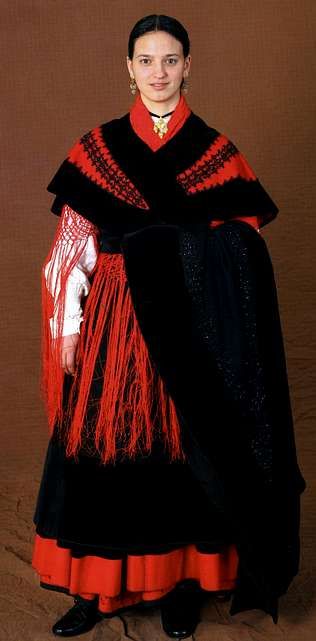
Postcard 22 has travelled to Virginia Beach. It features a group of people wearing our regional costume in As Burgas, our most famous hot springs.
Traditional costumes can be worn at special occasions. The most common are made of red wool and a pattern of black velvet stripes. The beadwork is stunning because they are all hand-cut azabache, a stone that was traditionally mined under the cathedral in Santiago de Compostela.
GALICIA FEMALE REGIONAL COSTUME
Upper part
8 point-shawl
Bodice
Sapo:
ornaments which are worn on the chest
‘Bolero’
jacket
Waistcoat
Dengue:
Piece of cloth, usually with velvet bits and inlaid with precious stones which
is worn on the back and with its two ends crossed on the chest to tie them
again to the back
Saia (Skirt) or vasquiña: It is usually long, although it does not necessarily have to touch the ground. It has to do one turn and a half around the waist
Apron. It is worn upon the skirt and tied to the waist
Mantelo or Muradana. Worn under the apron, it is much bigger than the latter and covers the skirt almost completely. It is usually decorated with velvet and precious stone designs.
Petticoats
Refaixo (under)skirt)
Pololos. Under the skirt. A sort of trousers with lace finishes on the edges. They reach below the knees.
Hoses or socks: of linen or wool, they can also be made of cotton or silk
Zocos or chancas [clogs]: Traditional shoes from Galicia, made of leather and with a woodensole
Cirolas: Undergarment in white linen, cloth or wool, similar to a pair of small underpants. They can be worn leaning out of the trouser leg and above the polaina [gaiter], or gathered and tied with a ribbon below the polaina.
Faixa: long, rectangular cloth finished with fringes, which surrounds the waist above the underpants. It usually does two turns around and can have different colours.
Polainas: a kind of hoses which go from the knees to the feet and generally black-coloured. They usually cover the front part of shoes. They are closed on the outer part of the leg with numerous buttons (if they are made of wool), buckles (in the case of leather) or laces (straw). Their appearance dates back to the 19th century and they replaced socks. They are often ornamented with a pompom matching the monteira.
Zocos or chancas [clogs]: Traditional shoes from Galicia, made of leather and with a wooden sole.
This video shows the Muiñeira, Galicia's typical folk dance:
Postcard 20 has travelled to Beijing in China. Diego sent a postcard featuring the colours of our flag, blue and white, and other elements that define where we come from.
Gastronomy
Try the seafood: barnacles, spider crabs, crabs,
lobsters... The clams and mussels are delicious. And the fish stews are
unbeatable. Inland, the octopus, empanadas (pies), stew and pork shoulder with
turnip tops are a must.
If you want to have a taste of our gastronomy, watch
the video below!
The Sea
The sea has also defined Galicia’s singular landscape,
with 1,200 km of stunning coastline offering great biodiversity which include
wide sweeping beaches with fine white sand, hidden away coves, spectacular
cliffs and beautiful islands and islets, as well as the characteristic rías or
estuaries which represent one of Galicia’s most distinctive features. This
landscape, so entwined with the unique cultural heritage offered by the sea and
fishing can be visited and enjoyed throughout the year, ably complemented by a
sumptuous and varied gastronomy which bases itself on products of excellent
quality, and charming accommodation in over one hundred rural guest houses.
The video below by
The Telegraph discovers Galicia’s stunning views and places:
Beijing, one of the world's most ancient cities, is the destination of postcard 20. It will travel 9,286 kilometres!!
We hope Nana likes this postcard written by Fran which features he colours of our flag, blue and white, and other elements that define where we come from.
Fran has visited various websites to find information about China's capital city. You can read what he has discovered in EXPLORING PLACES. You can also find a description of his postcard HERE.
The postcard that 3rd grade students sent to Marielle, from Uden (The Netherlands) features a map of our
autonomous community, Galicia. Galicia is a community in northwest Spain and is
a historic nationality under Spanish law. It comprises the provinces of A
Coruña, Lugo,Ourense and Pontevedra, being bordered by Portugal to the south,
the Spanish autonomous communities of Castile and León and Asturias to the
east, and the Atlantic Ocean to the west and the north. It had a population of
2,765,940 in 2013 and has a total area of 29,574 km2 (11,419 sq mi). Its
capital city is Santiago de Compostela.
Postcard 12 is on its way to Uden, a town in the South of the Netherlands, 1451 kilometres away!
Hope Marielle will like this illustration of Galicia, featuring some of its best-known emblems.
ç
This time, the postcard was written by 3rd grade primary students, supervised by their teachers, Mary and Quico.
Kids have done some research on Uden, click EXPLORING PLACES to read their findings. If you want to learn about Galicia, visit DISCOVER OUR HOMETOWN. Thank you, guys!