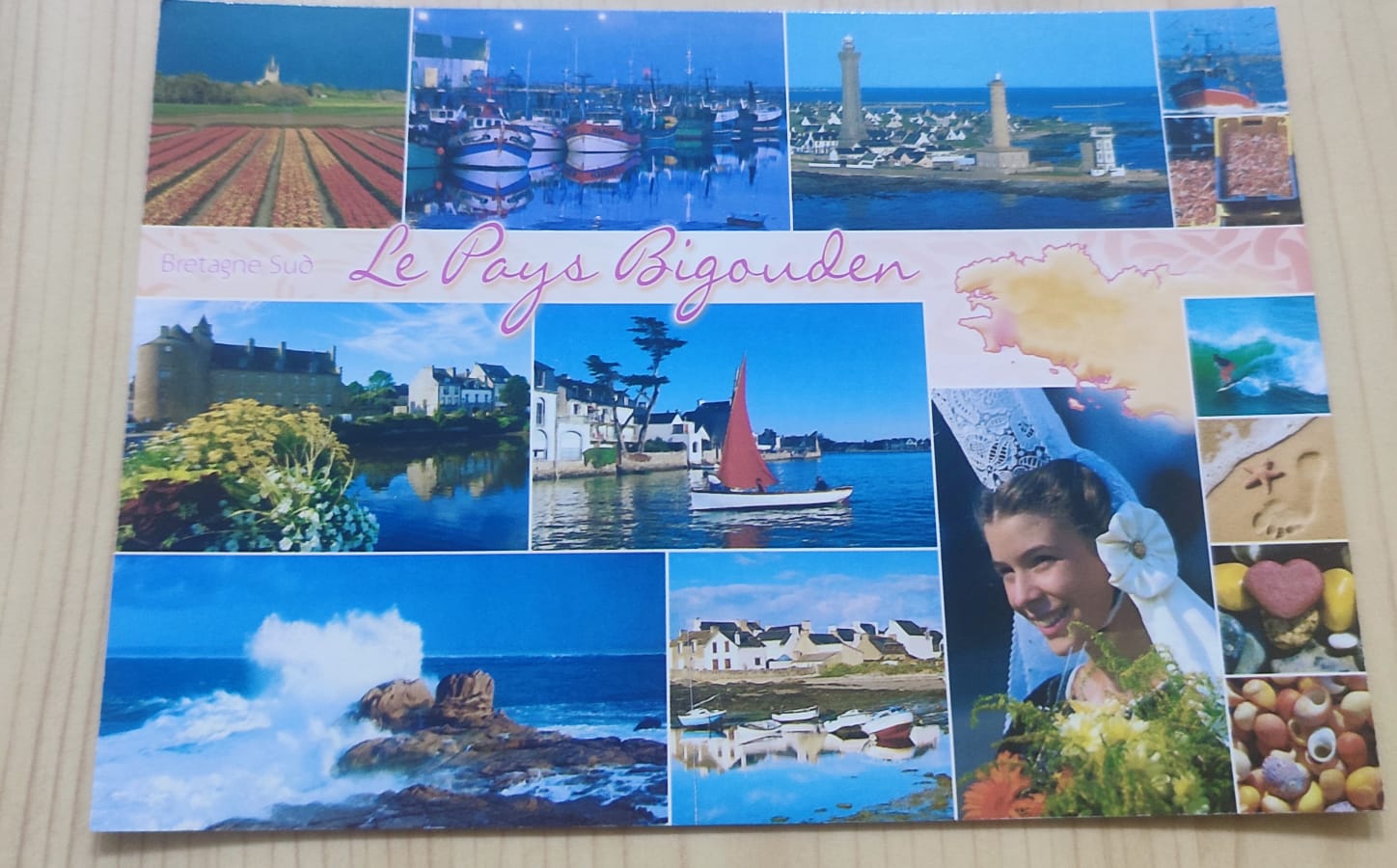
We've resumed Postcrossing at Padre Feijoo-Zorelle with a postcard exchange activity with students from Pont-l'Abbé, the capital of Pays Bigouden, a district located in southern Brittany, France.
Thank you to the students and teachers from Lycée René Laennec for their readiness to take part in this project, which has started with the reception of postcars in various languages in which students show landmarks and traditions of their homeland.
Merci beaucoup chers amis! Hope to hear from you soon!
After a two-month break, our postcrossers are back
with a postcard of Ourense’s Main Square sent to a village in the French Loire
Valley, Dadonville. ESO 3 students have been in charge of exploring Dadonville
and sending this postcard written in French.
Dadonville is a
village located in the Loire Valley region (now part of the Centre-Loire Valley
region), in the western-central part of France, 39 km from Orleans, the
department capital and 78 km from Paris.
DADONVILLE IS FAMOUS FOR…
…the impressive number of plants and flowers to be
enjoyed throughout the village; indeed, its wonderful planting is one of
Dadonville’s key attractions.The streets contain several traditional stone
houses making it very pleasant to explore, made more interesting by the small
river and bridge and, during the spring and summer, by its flowers and plants.
PLACES TO VISIT
Église Saint Denis
Yébre le Chatel Castle and Fortress
This Medieval castle dates from the first quarter of
the 13th century and is located in the hamlet of Yèvre-le-Châtel, 5 km from
Dadonville. Its design like many others of the time was heavily influenced by the
knowledge gained by the developments in military defensive architecture
witnessed during the 'Crusades'
By the 15th century however, the castle became
redundant with the advent of canon-power and although the castle was occupied
by the Huguenots In 1562, during the Wars of Religion, the collapse of its
interior vaults made it uninhabitable.
It was then left to crumble during the following century.The property of
the commune, it has been listed since 1862 as a monument historique by the French Ministry of Culture.
Arboretum des Grandes Bruyeres
The Arboretum des Grandes Bruyeres is a lovely
arboretum whose main features include a North American woodland garden, an
Asiatic woodland garden and of course lots of heather - bruyeres is the French
name for heather.The
arboretum was created in 1972 and is now a mature and well established
arboretum with more than 6500 trees and shrubs of 1400 species. The gardens are
beautifully laid out and there is something to see for every season (though
they close in the winter). The arboretum des Grandes Bruyeres has a national
collection of 1000 old roses and many are centred in this part of the garden.
In June the scent and sight of all these roses is magnificent.
To know more about the Loire Valley, the region where
Dadonville is located, watch this video:
The
destination of postcard 53 is Brive-la-Gaillarde, a town located in the French
region of Nouvelle Aquitaine. This is why French students decided to look for
information about Brive-la-Gaillarde and write a postcard to their French
friend, Mathilde.
Their postcard will travel 838 km! It features O
Parque do Toural, the best well-known green area in Xinzo da Limia; click here
to read more about this park.
French students have shared interesting information
about Brive-la-Gaillarde in EXPLORING PLACES. Merci à tous!!
The destination of postcard 53 is Brive-la-Gaillarde, a town located in the French region of Nouvelle L'Aquitaine, in the Southwest of the country, famous for being the subject of George Brassens, "Hécatombe au marche de Brive-la-Gaillarde"
Being a destination in France, French students decided to look for information about Brive-la-Gaillarde and have shared their findings with us. Below you can read their text in French, merci bien!
La
Brive-la-Gaillarde est situé entre le Massip Central et le Bassin aguitan
(causse carrézien) Il se situe au Nord d'Ussac et au sud.
Cette
zone a une population totale de 49.675 dans une zone de 48'59km², les habitent
s'appellent "brivistes". Le climat á Brive-la-Gaillarde est chaud et
temperé. Brive-la-Gaillarde c'est una ville avec une pluviométrie importante.
La température moyenne annuelle est de 12'7°C.
Il y a
beaucoup de lieux á voir dans cette zone, comme par exemple:
Grottes de Saint Antonio
Maison
dite Tour des Tchevins
Collegiale
de Saint Martin.
On peut visiter beaucoup de monuments et de lieux.
Les plus intéressants sont:
We have received a card from the capital of the French Riviera,
the Côte d'Azur crown jewel! Merci beaucoup Yves for choosing a lovely card showing
some of towns and villages of this French region that inspired painters like Marc Chagall and Henri Matisse.
Nice is located in the Côte d'Azur area on the south
east coast of France on the Mediterranean Sea. It is about 13 kilometres from
the principality of Monaco, and its airport is a gateway to the principality as
well.
NICE IS FAMOUS FOR...
...its natural beauty and its mild Mediterranean
climate, which make the area a favourite holiday destination for tourists
worldwide.
The city's main seaside promenade, the Promenade des Anglais
("Walkway of the English') owes its name to British upper classes who
spent their winters here in the 18th century seeking relaxation and good
weather. The clear air and soft light have also appealed to some outstanding
painters, such as Marc Chagall, Henri Matisse, Niki de Saint Phalle and Arman.
Their work is commemorated in many of the city's museums, including Musée Marc
Chagall, Musée Matisse and Musée des Beaux-Arts.
This walkway extends from the airport on the west to the Quai
des États-Unis (United States Quay) on the east, a distance of approximately 7
km. On Sundays, bicyclists, baby strollers, and whole families can be seen out
for a stroll along the Promenade. It has also become a favorite place for
skateboarders and in-line skaters.
Located on the Promenade des Anglais, this beautiful
hotel was inaugurated in 1913 and stands today as one of the most amazing
buildings in the city. The Negresco has a total of 119 guest rooms plus 22
suites and was listed by the government
of France as a National Historic Building in 2003.
The Castle of Nice was originally a citadel used for
military purposes. Built at the top of a hill, it stood overlooking the bay of
Nice from the 11th century to the 18th century. It was besieged several times,
especially in 1543 and in 1691, before it was taken by French troops in 1705
and finally destroyed in 1706 by command of Louis XIV.
Nowadays, Castle Hill is used as a park. It's the most
famous public garden in Nice, and a "must see" place for the numerous
tourists who visit the city. It offers many amazing panoramas, and provides a
beautiful view all day long from sunrise to sundown, highlighting various
landscapes depending on where one looks: the Harbor at sunrise, the Promenade
des Anglais at sundown. That's why Castle Hill is called "the cradle of
the sun".
Located in the old town, the cathedral of Nice was
built between 1650 and 1699, the year of its consecration. It is dedicated to
the Assumption of the Virgin Mary and Saint Reparata. It has been classed as a
monument historique since 9 August 1906.
LIFESTYLE
Apart from being a holiday resort, Nice has a very
rich cultural offer. There are numerous museums of all kinds: Musée Marc
Chagall, Musée Matisse (arenas of Cimiez containing Roman ruins), Musée des
Beaux-Arts, Musée international d'Art naïf Anatole Jakovsky, Musée Terra-Amata,
Museum of Asian Art, Musée d'art moderne et d'art contemporain which devotes
much space to the well-known École of Nice ”), Museum of Natural History, Musée
Masséna, Naval Museum and Galerie des Ponchettes.
Nice also hosts many festivals throughout the year,
such as the Carnaval de Nice and the Nice Jazz Festival and has a diverse
cuisine given its geographical location: it is especially close to those of
Provence but also Liguria and Piedmont
in Italy and uses local ingredients (olive oil, anchovies, fruit and
vegetables).
Summer holidays start today and this means the end of
classes and of our activity for this academic year. We would like to express our special thanks
to the students and teachers who have taken part in this project; it’s been so exciting
to send postcards to so many different countries and read all the interesting
information you’ve shared about Ourense and the destination/origin of the
different cards!
We’ve received 58 cards and have sent 48 so far, which
makes a total of 106 travelling postcards! Postcrossing at Padre Feijoo-Zorelle has been a huge success and we look
forward to sending more cards in September, when we come back from summer
holidays.
Please, keep posting your comments on your favourite
entries, this last one includes the last four postcards with which we conclude
this school year: Stop 45: Sastamala, Finland