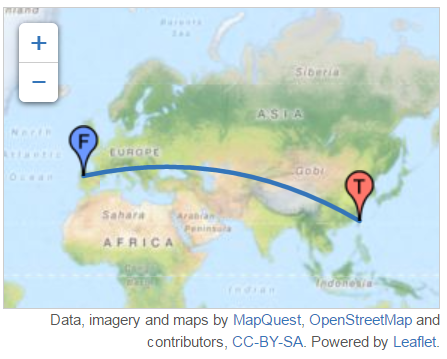
Postcard 33 is travelling to New Taipei City, Taiwan, 10,901 km away!
Miguel Quiroga has written a colourful postcard featuring the "Cigarróns", the best-known figure in Verín's Entroido!
Miguel has done some research on New Taipei City and has shared his findings in EXPLORING PLACES. He has also found interesting information about the "Cigarróns" and the town of Verín. You can read his text in DISCOVER OURENSE.
New Taipei City is
a special municipality and the most populous city in Taiwan. Located in
northern Taiwan, the city includes a substantial stretch of the island's
northern coastline and surrounds the Taipei Basin, making it the second largest
special municipality by area, behind Kaohsiung.
New Taipei City
was originally a county known as Taipei County before 2010, which surrounds
Taipei. After the county's population overtook that of Taipei, it was decided
that the county should be upgraded to city status.
This is one of the
oldest temples in Taipei City, it was built in 1738 by the first Chinese
settlers, who came from Fujian. The temple is open to Buddhism, Taoism and
traditional Taiwanese beliefs. This is also the center of Taipei’s oldest
district Wanhua, which is famous for some of the biggest and most traditional
markets in the city. The nearby Huaxi Street Night Market is famous for its
snake alley, the Guangzhou Street Night Market is the biggest night market,
full of traditional “xiao chi” or “little eats”, popular street food enjoyed by
young and old.
These are two
historic neighbourhoods within the old Datong district. Together with Wanhua
district it forms the so called Old Taipei, the part of the city, that was
inhabited by Fujianese settlers in the early 18th century. Dadaocheng is famous
for old temples and the very long Dihua Street, one of Taipei’s oldest streets,
which is famous for its colonial Japanese architecture as well as a plenty of
traditional shops. The street is especially lively during the annual Spring Festival,
the so called Lunar New Year.
Taipei City is the
political center of Taiwan (officially Republic of China), bearing a great
significance locally, as well as regionally. Two historic figures, that have
not only greatly impacted the modern
history of Taiwan, but also history of China, are honored with two iconic
memorial halls. The first is the Sun Yat-sen Memorial Hall, dedicated to Sun
Yat-sen, the founder of the Republic of China in 1911 in Nanjing. The Chiang
Kai-shek Memorial Hall is dedicated to one of his successors, generalissimo
Chiang Kai-Shek, who continued the Republic of China on Taiwan in 1949 and
ruled as president until his death in 1974.
His majestic 76m tall memorial hall
is located in Taipei’s biggest square named Liberty Square. The neo-classical
Chinese architecture is dominating the area together with the National Theatre
as well as the National Concert Hall, who are also found here.
Located beside Beitou
Hot Spring Park, Thermal Valley is one of the sources supplying the area’s hot
springs. The sulfuric steam that blankets the valley year-round gives the
valley a frightening quality, giving rise to nicknames like “Ghost Lake.”
The
springs here have the highest temperatures of any in the Datunshan volcano
group. With its surreal sulfuric atmosphere, it’s no wonder Thermal Valley was
considered one of the “12 great sights of Taiwan” during the Period of Japanese
Occupation.
LIFESTYLE
Although Taipei is
somewhat like a large Western city with its go-go attitude, it's very different
in other ways.
Watch the video
below to find out all the opportunities New Taipei City has to offer!
Postcard 24 will travel 11,890 kilometres before our Taiwanese friend, Tiffany, receives it!
Hope Tiffany likes this postcard written by Ismael and that features one of the most famous Carnival celebrations in Ourense: Xinzo de Limia's Entroido and its well-known pantallas!
Ismael has found very interesting information about Hsinchu City and has shared it with us HERE. Remember that you can also read about Xinzo's Entroido in our section DISCOVER OURENSE.
Hsinchu officially
known as Hsinchu City (Chinese: 新竹市), is
a city in northern Taiwan. Hsinchu is popularly nicknamed "The Windy
City" for its windy climate. Hsinchu is administered as a provincial city
within Taiwan.
18 Peaks Mountain
Park was designated a forest park back in 1928 during the era of Japanese rule.
The park stretches eight kilometers from north to south in a crescent shape,
embracing the city from the southeast. As its name suggests, the mountain is composed
of 18 peaks. The Jieshou Pavilion of Longevity sits at the highest point in the
park, 131.79 meters above sea level. Winding through dense woods, the trails
used to be rough and remote. But in recent years, the city has redone the trail
system here, paving some trails with asphalt, and adding an "Osmanthus
Alley" so that the going is easier and adding pavilions so that hikers can
stop to rest and drink free tea.
This lake has been
opened for quite some time now and is part of a reservoir which stores water
from the Yaker River. Although small in size, the lake is the oldest scenic
spot in Hsinchu and fringed by centuries old temples amid lush greenery.
Qingcao Lake used
to be a mini-sized lake hundreds of years ago, which was also used as a dam.
After the end of the Japanese colonial period in Taiwan, the first magistrate
of Hsinchu County ordered to reconstruct the dam, resulting in a 30 square
kilometer area for storing water. It was the first large-scaled construction in
Hsinchu since the establishment of the local government.
Hsinchu Station is
a railway station on the Taiwan Railway Administration (TRA) Western Line and
the Neiwan Line. It is located in East District, Hsinchu City, Taiwan. Hsinchu
Station is a major station on the Western Line and the western terminus of the
Neiwan Line.
The main building
of this station is one of the oldest train stations alongside Taiwan's Western
Main Line, its Baroque style main structure was built in 1913 during the Japan
Occupation Era, and has been appointed as National Heritage Site.
The East Gate
Established in
1733, the city used to be surrounded by bamboo groves. Hence, it was given the
name "Chuchien," which means "bamboo wall." In 1826,
members of the local gentry asked the authorities to erect a city wall made of
brick and stone, and the request was granted. Construction started in 1827, and
four gate towers were erected. As a result of city planning during the Japanese
era, the wall and other gates were torn down in 1902, leaving only the East
Gate.
The East Gate has
a granite foundation with an arched doorway and a tower on top. Originally a
wooden structure, the tower was later rebuilt with concrete. It has 24 pillars
and a gable-and-hip roof with double eaves. Elegant pendants hang below the
upturned swallowtail eaves. Square loopholes on the battlements were used to
shoot through. A stele beside the gate documents the history of Chuchien.
Built in the
mid-18th century, this temple was commissioned by an officer of Tamshuen Jen
Z-ing. The temple is fronted by a pair of stone-carved lions and is otherwise
characterised by delicate wood carvings. Inside, it is possible to spend an
hour or more simply admiring the intricately-crafted decor.
LIFESTYLE
Taiwan is a
modern, free, democratic society whose people are hardworking, fun-loving,
educated and friendly. While eagerly embracing the future, the people of Taiwan
hold onto traditional values and ideals. The family, including ancestors, is of
utmost importance; education and scholarship are held in high esteem. The
family, including ancestors, is of utmost importance; education and scholarship
are held in high esteem.
Hsinchu City,
Taiwan is a high-tech community blessed with mountain and coastal scenery. Its
green mountains and blue water are simple, yet pleasant and beautiful to
behold. Aiming to promote a dual theme of technology and culture, the local
government is making strong efforts to set up more parks, plant more trees and
flowers so that Hsinchu City also becomes a garden city with birdsong,
fragrance, happiness, abundance, health, success.
Tainan is the oldest city inTaiwanand also commonly known as the "CapitalCity" (Chinese:府城;pinyin:fǔchéng) for its over 200 years of history as the capital of Taiwan undervarious ruling dynasties.Its former name, Tayouan (大員), has been claimed to be the origin of the name "Taiwan".
The TaiwanConfuciusTemple was built in 1665 to offer lectures and cultivate intellectuals. It was the first learning institute for children when Taiwan was ruled byQing Dynasty. The Confucian temple serves now as a popular tourist attraction and hosts ancient Confucian ceremonies.
TheNational Museum of Taiwan Literature exhibits local literary works as part of its multilingual, multi-ethnic focus. The museum is located in the former TainanCity Hall, constructed in 1916 and famous for its historical significance.
The Bee Hives are the most important fireworks inLantern Festival. They are actually thousands of bottle rockets arranged row atop row in an iron-and-wooden framework. The setup looks like a beehive full of unleashed gunpowder. Dazzling explosives whiz and whirl across the sky and often into the spectators, both thrilling and intimidating them.
LIFESTYLE
Tainan is also one of Taiwan's cultural capitals, for its rich folk cultures including the famouslocal snack food, extensively preservedTaoistrites and other living local traditions covering everything from child birth to funerals.
Postcard 8 is heading to Tainan (Taiwan), 11,009 kilometres away!
This time it was our primary school teacher, Quico Rodríguez, who wrote a postcard featuring the well-known thermal baths in Outariz. Thank you, Quico!
If you want to learn about this Taiwanese city, visit our section EXPLORING PLACES. Go to DISCOVER OUR HOMETOWN to read about the Termas de Outariz in English!