Irene is an Italian student whose reading recommendation was Harry Potter and the Philosopher's Stone, the first novel in the Harry Potter series and J.
K. Rowling's debut novel, first published in 1997 by Bloomsbury.
Irene spent one lesson with us and we could ask her
questions about her country and reading habits. She also asked us some
questions about our culture and traditions and about our reading preferences,
of course!
It was so good to
have her with us! Grazie mille, Irene!
We have received our first card from Italy! It's been quite a coincidence since the last card we mailed was also sent to this country! It has travelled 1,367 kilometres!
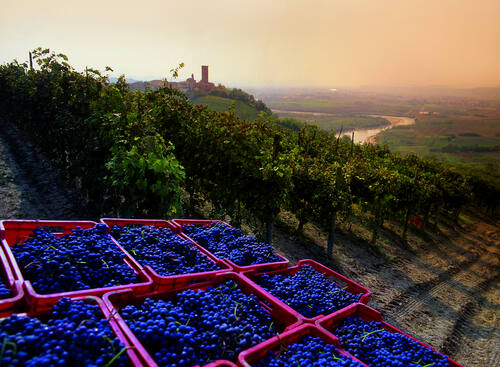
Grazie tanti, Paola, for having chosen a card that shows us what Castellinaldo is famous for!
Castellinaldo has one of the oldest wine making traditions in the world and present-day Castellinaldo vine growers produce and sell a very appreciated and exclusive brand of red wine, Marsaglia.
Luca Spesatto, one of our friends from Italy, has very kindly recorded this podcast to share with us interesting information about Castellinaldo and the whole region of Piedmont. Grazie mille, Luca!
Luca Spessato, a friend of our project, has very kindly sent us a podcast on the beautiful Italian region of Piedmont after knowing that we’ve received a postcard from Castellinaldo!
Grazie mille Luca
for telling us so many interesting things about the history, culture and
lifestyle of Piedmont!
Luca Spessato
You're welcome
to take part in our project any time you want!
Castellinaldo is a village of around 900 inhabitants in the region of Piedmont, in the Northern part of Italy. Piedmont is one of
the 20 regions of Italy. Its capital is Turin. Piedmont is in Italy's
northwest and borders Switzerland and France. It is the second largest of
Italy's 20 regions, after Sicily.
We have sent our first postcard to Italy! Postcard 28 is off to Brescia, a town located in the region of Lombardy in the northern part of the country, 1487 km from Ourense!
We hope Monica and Giuseppe, will appreciate Rafael Cachaldora's marvellous illustration of a well-known street in Ourense's old town, rúa Viriato.
Thank you Valeria for writing this postcard and let our Italian friends know about this lively street, the meeting place for anybody who would like to enjoy Ourense's nightlife.
If you want to know what Rúa Viriato is like, visit our section DISCOVER OURENSE.
Valeria has virtually explored Brescia and has found out many interesting facts which have been published in EXPLORING PLACES.
Brescia is a city and comune in the region of Lombardy
in northern Italy. It is situated at the foot of the Alps, a few
kilometres from the lakes Garda and Iseo. With a population of 196,120, it is
the second largest city in the region and the fourth of northwest Italy. The
urban area of Brescia extends beyond the administrative city limits and has a
population of 672,822. The city is the administrative capital of the Province
of Brescia, one of the largest in Italy, with over 1,200,000 inhabitants.
The ancient part of Brescia, Roman Brixia so-called
since the first century BC because of the rocky, hilly ground on which it is
built , is bounded to the north-east by Cidneo Hill (245m). Brich was the
Celtic word meaning rocky summit, high places. And the hill with its wonderful
view over the whole city, has represented the most important element in the
town's history from the time of the
first settlements in the Bronze age up until the eve of the XX century.
The convent of San Salvatore, later named after Santa Giulia (915) was
founded at the wish of King Desiderius and his wife Ansa in 753 AD, and built
on a particularly rich archeological site ( the remains of Roman domus have
been found under the basilica of San Salvatore and in the kitchen garden of
Santa Giulia.
It is the most beautiful square in Brescia and was
inaugurated in 1433. It is dominated by the magnificent Renaissance Palace of
the Loggia, nowadays the town hall. Its building began in 1492. The upper part
was finished circa 1570 to the design of Jacopo Sansovino and Andrea Palladio.
The splendid decorative sculpture that adorns the palace is in classical style.
On the south side, the
15th and 16th century façades of the Monti di Pietà are worthy of note as tombstones and other
pieces of Roman stonework have been set into their walls.
The present loggia was
built to replace the previous one built between 1434 and 1436. The first stone
was laid in 1492 with a solemn ceremony and the building work continued until
about 1570, under the supervision of numerous architects: Tommaso Formentone,
then Gasparo da Coirano, Andrea Palladio, Jacopo Sansovino, Galeazzo Alessi,
Giovanni Rusconi and Ludovico Beretta.
The Queriniana library was founded
in 1747 and opened to the public by Cardinal Angelo Maria Querini, formerly
librarian at the Vatican library, well known for his bibliophily.
He had the monumental palace designed and built by the
architect Marchetti and donated his remarkable private bibliographic
collections, legating a considerable sum to enable the library to expand in the
future.
It was built at the end of the XI century on the ruins
of the winter basilica of Santa Maria Maggiore. The central block is formed of
two cylindrical parts of stone, one on top of the other; the circular
ambulatory still has the original doorways, which are lower than the present
street level, and has large arched windows, while the upper tambour has smaller
windows and is relieved above by pilaster strips and small arches in brick, on
which the roof rests.
LIFESTYLE
Known as a city for culture lovers for the quality of
its architecture, museums and exhibitions, it’s a perfect town for strolling.
Small, with much of the historic centre pedestrianized, it is full of ancient
buildings, attractive shops and piazzas. Unlike many other cities, the modern
business development has been kept out of the city’s heart, giving the historic
centre great visual appeal.
Brescia has some very good options for dining out. The
best thing to try in the city would be local food; Brescian food is known to be
quite hearty and heavy on butter and beef. Some good local dishes to try are
Casoncelli, tortellini with beef, polenta taragna, spiedo etc. Another thing to
try here are pizzas, there are plenty of pizzerias here in Brescia that have
some great varieties of pizzas. Also, there are plenty of cafes and Osterias
here that sell some great local cuisine. There are quite a lot of local dishes
like polenta which are only available here during winters.