19/12/2015

Merry Christmas and Happy New Year!


Before 2015 comes to an end, we would like to share with you a wonderful video created by Bachillerato students with a number of 10 inspirational quotes to begin 2016 with motivation and strength!


We will be back to our regular posting on January 7th. HAPPY HOLIDAYS!

17/12/2015

Exploring Places XXVI: Singapore

We have received a postcard from SINGAPORE!

Singapore nightview

WHERE IS SINGAPORE?

Singapore is an island in Southeast Asia. It was part of Malaysia until it became an independent republic in 1965.

Location of Singapore

SINGAPORE IS FAMOUS FOR...

...being a global, commercial and financial hub.

PLACES TO VISIT

Singapore offers a wide variety of places to visit. Some of them are the following:

Chinatown

Ana Romero in Singapore's Chinatown


Little India

Little India. Photo by Ana Romero

The Financial District

Singapore's Financial District. Photo by Ana Romero

Marina Bay

Marina Bay. Photo by Ana Romero

Clark Quay

Clark Quay. Photo by Ana Romero

LIFESTYLE

Singapore is a very lively city with a very standard lifestyle. Most people speak English. It’s a very safe, clean and green city with an excellent transport system.

If you want to discover more about this multicultural country, listen to the interview with Ana Romero.


Thank you so much, Ana, for your help and for sharing with us your beautiful pictures!

Interviewing Ana Romero about Singapore

Ainhoa (2º ESO A) has interviewed Ana Romero about Singapore, the origin of the 11th postcard we've received. Ana lived there a few years ago and she's currently working in the Export Sales department of a Cosmetics Company. Thank you, Ana, for letting us know about this faraway place!

Ana in Chinatown (Singapore). Photo by Ana Romero

The press covers our project again!

Here you have an image of the report La Región published yesterday!


We have received a postcard from Singapore!

We have received another postcard! This time from Singapore, 11,671 km away!

Ashlyn sent us a very original postcard showing an equation, the student life equation. Thank you, Ashlyn, we love it!


Ainhoa (2º ESO A) has interviewed Ana Romero, who lived in Singapore for a few years ago and who’s currently working in the Export Sales department of a Cosmetics Company. Click PLAY below to listen to the interview. Thank you Ana for letting us know more about this faraway country! 
You may also visit EXPLORING PLACES to read Ainhoa's findings.


Erasmus students visit us!

Big news today!
We are really happy to announce that our project is collaborating with the Erasmus student association in Ourense. Laura Rodríguez, the association’s coordinator, learned about Postcrossing at our school a few weeks ago and very kindly offered her support, suggesting that Erasmus students’ participation will greatly enrich the project.


ESO 4 students have received the visit of two French-speaking Erasmus students. It has been a wonderful chance to exchange information about culture and traditions in French-speaking countries.


 Merci bien!


12/12/2015

Discover Ourense: Río Limia or River Lethes


The River Lethes is in the town of Xinzo de Limia, which lies on the fertile valley of Antela, approximately 43 km from Ourense. The Limia passes through the town on its way south towards the Portuguese border.


As noted on the previous postcard, Xinzo is well-known for its Carnival. It is one of the longest in Spain. You may well remember that the Pantalla is the main figure of the carnival in Xinzo, and runs through the streets in groups of two or three with two swollen pig bladders in the hands making huge noise. If the pantalla finds a male relative or neighbour without a disguise, they will take him into a bar, to pay the fee for not being dressed properly, which is a glass of wine. The group of pantallas will sing a couple of traditional Galician songs while they have the glass of wine.

Image by Eva Pousa and Antía Pousa
Image by Eva and Antía Pousa

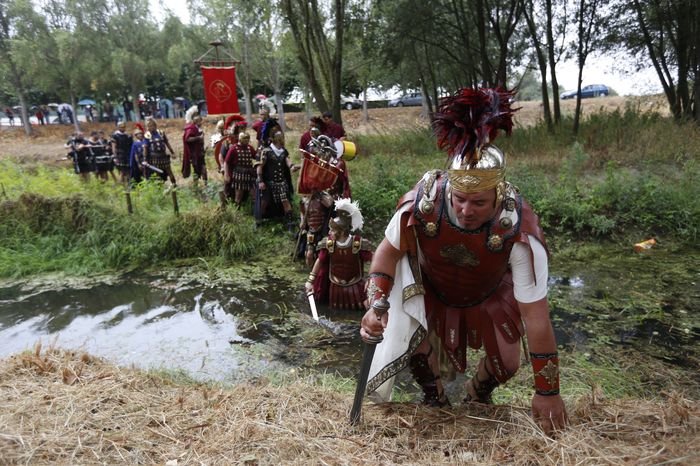
There is a legend connected to Xinzo. Several classical authors reproduce the myth of the loss of memory connected to crossing the Límia, referred by them as Lethes or Oblivionis. In 138 BC the Roman chieftain Decimus Junius Brutus put an end to the myth told by the Galicians when, on crossing the river, he began to call each one of his legionnaires by their names from the opposite bank. That historical fact has been now represented in an historical party called Festa do Esquecemento, which is celebrated on the third weekend of August every year.

Festa do Esquecemento