
Postcard 22 has travelled to Virginia Beach. It features a group of people wearing our regional costume in As Burgas, our most famous hot springs.
Traditional costumes can be worn at special occasions. The most common are made of red wool and a pattern of black velvet stripes. The beadwork is stunning because they are all hand-cut azabache, a stone that was traditionally mined under the cathedral in Santiago de Compostela.
GALICIA FEMALE REGIONAL COSTUME
Upper part
- 8 point-shawl
- Bodice
- Sapo: ornaments which are worn on the chest
- ‘Bolero’ jacket
- Waistcoat
- Dengue: Piece of cloth, usually with velvet bits and inlaid with precious stones which is worn on the back and with its two ends crossed on the chest to tie them again to the back
- Justillo [tight sleeveless undershirt]
- Xubón [doublet]
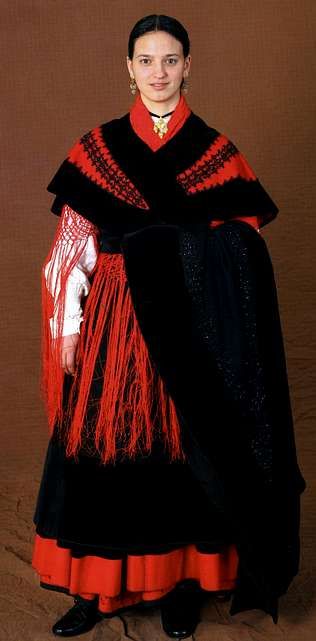 |
| Female traditional costume. Wikimeda Commons |
Lower part
- Saia (Skirt) or vasquiña: It is usually long, although it does not necessarily have to touch the ground. It has to do one turn and a half around the waist
- Apron. It is worn upon the skirt and tied to the waist
- Mantelo or Muradana. Worn under the apron, it is much bigger than the latter and covers the skirt almost completely. It is usually decorated with velvet and precious stone designs.
- Petticoats
- Refaixo (under)skirt)
- Pololos. Under the skirt. A sort of trousers with lace finishes on the edges. They reach below the knees.
- Hoses or socks: of linen or wool, they can also be made of cotton or silk
- Zocos or chancas [clogs]: Traditional shoes from Galicia, made of leather and with a woodensole
GALICIA MALE REGIONAL COSTUME
 |
| Traje tradicional gallego. Trajestradicionales.com |
- Cirolas: Undergarment in white linen, cloth or wool, similar to a pair of small underpants. They can be worn leaning out of the trouser leg and above the polaina [gaiter], or gathered and tied with a ribbon below the polaina.
- Faixa: long, rectangular cloth finished with fringes, which surrounds the waist above the underpants. It usually does two turns around and can have different colours.
- Polainas: a kind of hoses which go from the knees to the feet and generally black-coloured. They usually cover the front part of shoes. They are closed on the outer part of the leg with numerous buttons (if they are made of wool), buckles (in the case of leather) or laces (straw). Their appearance dates back to the 19th century and they replaced socks. They are often ornamented with a pompom matching the monteira.
- Zocos or chancas [clogs]: Traditional shoes from Galicia, made of leather and with a wooden sole.


